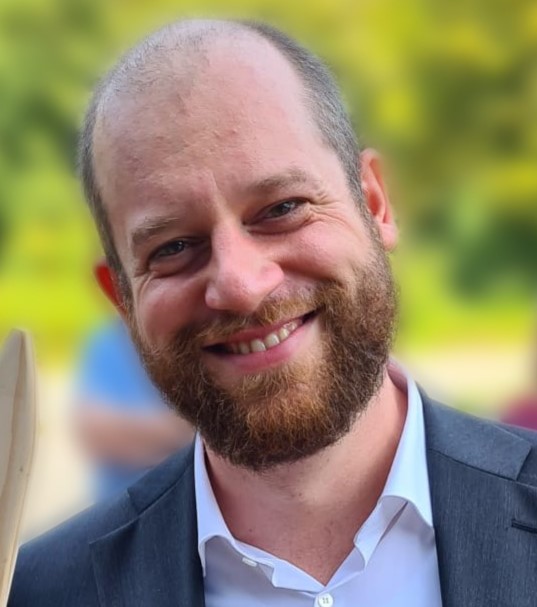
Dr. Matthias Ehlenz
Computer Scientist · RWTH Aachen University · Head of Operations, MediaLab Lehramt
Digital media only unfolds its potential for education once the technology becomes accessible to those who create the content: teachers, trainers, and domain experts.
Research, teaching, and transfer as one cycle
I am a computer scientist (Dr. rer. nat., RWTH Aachen University) and a trained teacher of computer science and chemistry. For more than ten years I have been working at the intersection of computing and education — from collaborative learning games on interactive tabletop displays and multimodal learning analytics infrastructures to accessible authoring tools for digital and immersive learning environments.
At the Teacher Training Center (Lehrerbildungszentrum) of RWTH Aachen University I built the MediaLab Lehramt, which I now lead operationally; following a very positive evaluation by the rectorate, it was made permanent in 2026 with two tenured positions. I see teaching, research, and transfer not as separate duties but as one cycle: research produces tools, tools drive courses and teacher training — and their use raises new research questions.
(DELFI, LAK, MuC)
(LTI Lab, MediaLab)
How do digital learning environments become accessible, collaborative, and evidence-based?
My research follows this guiding question in four interlocking strands — connected by learning analytics and data-driven evaluation as a cross-cutting theme.
Accessible authoring tools
Teachers and domain experts across all disciplines should be able to create digital learning content themselves — from interactive web applications to immersive 360° environments. I address this gap with the open-source project 19squared, a collaborative authoring tool for interactive learning environments — usable from desktop and tablet to VR headset.
Interdisciplinarity
Accessible tools turn digital media into a cross-cutting technology that connects disciplines. In close cooperation with subject didactics and disciplines — from biology and English studies to mechanical engineering, chemistry, technology, and physics — dedicated teaching-and-learning scenarios emerge. One example is Sci-Fo/Voedselbos, a cross-border project that, together with biology, opens up a real food forest in the Meuse–Rhine Euroregion as an immersive learning site using 19squared.
AI in education
Generative AI is changing how learning content is created and experienced. I study AI as a tool that makes authoring more accessible and learning environments more adaptive: LLM-based agents supporting educators in authoring (LAK 2026), AI-supported media generation, and RAG-based learning companions — complemented by teacher training on PersonalGPTs in education.
Social & Collaborative Learning
From my doctoral research on computer-supported collaborative learning I bring a deep methodological understanding of how people learn together at and in shared interactive environments — from interactive tabletop displays and collaborative authoring to social simulations such as the VR classroom simulation Teach-R.
Learning analytics & evaluation
Building on open standards (xAPI) and privacy-aware architectures, I make construction and usage processes in digital learning environments visible — from saliency maps of visual attention in 360° scenes to dashboards for educators. All results are consistently released as open source or OER.
Selected projects
19squared
Collaborative authoring tool for interactive 360° learning environments with integrated learning analytics — initiated and substantially developed by me. Presented internationally at LAK 2025/2026, nationally at DELFI, and in 2025 at LEARNTEC in Karlsruhe. → Repository (RWTH GitLab)
MediaLab Lehramt
Teaching-and-learning lab for digital media as a cross-cutting theme in teacher education at RWTH Aachen — conceived, built, and operationally led by me, made permanent in 2026. Broad XR portfolio from Pico and Meta Quest to Valve Index; immersive learning scenarios created with biology, English studies, mechanical engineering, chemistry, ergonomics, technology, and physics. → MediaLab website
D4MINT
Competence center for digitalization in STEM education — a consortium of the universities of Aachen, Gießen, Oldenburg, and Potsdam. Project coordination plus development of authoring tools and teacher training on collaborative learning games; successfully completed in 2025.
OPEN_SPACES_AACHEN
Funded consortium project in the federal OE_Erfahrungsräume (Open Educational Resources) funding line, together with the RWTH Aachen School of Architecture and the civil-society initiative Zusammenstadt. I lead the MediaLab sub-project; all results are released as open educational resources (2026–2029).
Teach-R user hub
User hub for the VR classroom simulation Teach-R at MediaLab Lehramt: connecting developers and practitioners across the teacher-education region, third-party funding acquired for major extensions, co-host of the 2025 developer and user meeting in Aachen.
Learning Technologies Innovation Lab
Multimodal laboratory for learning technologies research at RWTH Aachen — eye trackers, depth cameras, microphone arrays, and VR systems, connected by a sustainable multimodal learning analytics infrastructure of my design.
AI training for teachers
Winner of a Stifterverband ideas competition: design and delivery of AI-related professional development formats for teachers — currently in progress.
Selected publications
- Ehlenz, M. (2026). 360°-Medien für konstruktivistisches Lernen mit VR. journal für lehrerInnenbildung (jlb), 26(1), 174–184.
- Frank, S. & Ehlenz, M. (2026). Supporting Educators through AI: Human-AI Collaboration in Authoring Immersive 360° Learning Experiences. Companion Proceedings, 16th International Conference on Learning Analytics & Knowledge (LAK26).
- Ehlenz, M., Maquet, F. & Heinemann, B. (2025). 19squared: A Collaborative Authoring Tool with Learning Analytics for Immersive 360° Educational Experiences. Companion Proceedings, 15th International Conference on Learning Analytics & Knowledge (LAK25).
- Heinemann, B., Ehlenz, M. & Schroeder, U. (2025). Didaktische Konzepte fürs Onboarding und Tutorials in VR-Lernanwendungen. DELFI 2025 — 23rd Conference on Educational Technologies, German Informatics Society (GI).
- Ehlenz, M., Heinemann, B. & Schroeder, U. (2022). Open Research Tools for the Learning Technologies Innovation Lab. International Journal of Online and Biomedical Engineering (iJOE), 18(14). doi:10.3991/ijoe.v18i14.35077
Teaching by conviction
My teaching philosophy is constructivist: students learn best with and from each other, in activating, project-based settings. The heart of my teaching are project courses with real target groups — my students have built learning games, authoring tools, and XR applications for schools, teachers, and research labs: software that is still in use today.
Since 2015 my teaching has ranged from foundational courses to disciplinary and subject-didactics teaching, seminars, lab courses, and research focus classes — in German and in English. I have supervised more than 60 theses, most recently predominantly on 360° learning environments, web-XR infrastructures, and AI-supported authoring.
Ongoing courses
Lab course “Smart Offline Caching for Immersive 360° Learning Environments” and seminar “AI as Co-Teacher? Opportunities and Challenges of Generative AI in Schools” (both in English, RWTH Aachen University).
Teacher training portfolio
- Virtual 360° field trips
- Game-based learning & gamification
- PersonalGPTs in education
- Hybrid & self-paced formats
Career
-
Since 08/2025
Assistant to the Managing Director, Teacher Training Center, RWTH Aachen University
Permanent position; also head of operations of MediaLab Lehramt.
-
Since 11/2021
Founder & head of MediaLab Lehramt, RWTH Aachen University
Conception and realization of a teaching-and-learning lab for digital media in teacher education; made permanent in 2026 after a positive evaluation by the rectorate.
-
2023 – 2025
Project coordinator, D4MINT (BMBF initiative lernen:digital)
Competence center for digitalization in STEM education, consortium of four universities; successfully completed.
-
08/2023
Doctorate (Dr. rer. nat.) in Computer Science, RWTH Aachen University
“A Sustainable Research & Development Ecosystem for Computer-Supported Collaborative Learning with Interactive Tabletop Displays” — magna cum laude, advised by Prof. Dr. Ulrik Schroeder.
-
2015 – 2021
Research associate, Learning Technologies (Computer Science 9), RWTH Aachen University
Research on CSCL, multimodal learning analytics, game-based learning, and open science; built the Learning Technologies Innovation Lab.
-
04/2015
First State Examination / Dipl.-Gyml. (Computer Science & Chemistry), RWTH Aachen University
Teaching degree for grammar and comprehensive schools, grade “very good”.
Engagement in the research community
Networks & committees
- XR-Learning working group of the GI special interest group on educational technologies — workshops and network proposals
- DELFI (Conference on Educational Technologies): program committee member since 2023, demo chair & organizing team 2023
- Reviewer: LAK, EC-TEL, DELFI, ITiCSE, and the AVRiL competition for outstanding VR/AR learning scenarios
- Co-initiator of the “VR in Higher Education” exchange at RWTH Aachen
- Member of the German Informatics Society (GI) and the ACM
Awards
- Best Demo Award — DELFI 2022, Karlsruhe
- Best Demo Award — LAK 2021
- Best Demo Award — DELFI 2019, Berlin
- Best Demo Award — DELFI 2018, Frankfurt
- Best Demo Award — Mensch und Computer 2016, Aachen
Get in touch
Research collaboration, talks, teacher training, or XR projects — I am happy to hear from you at mail@matthias-ehlenz.de.